
This is for informational purposes only. For medical advice or diagnosis, consult a professional.
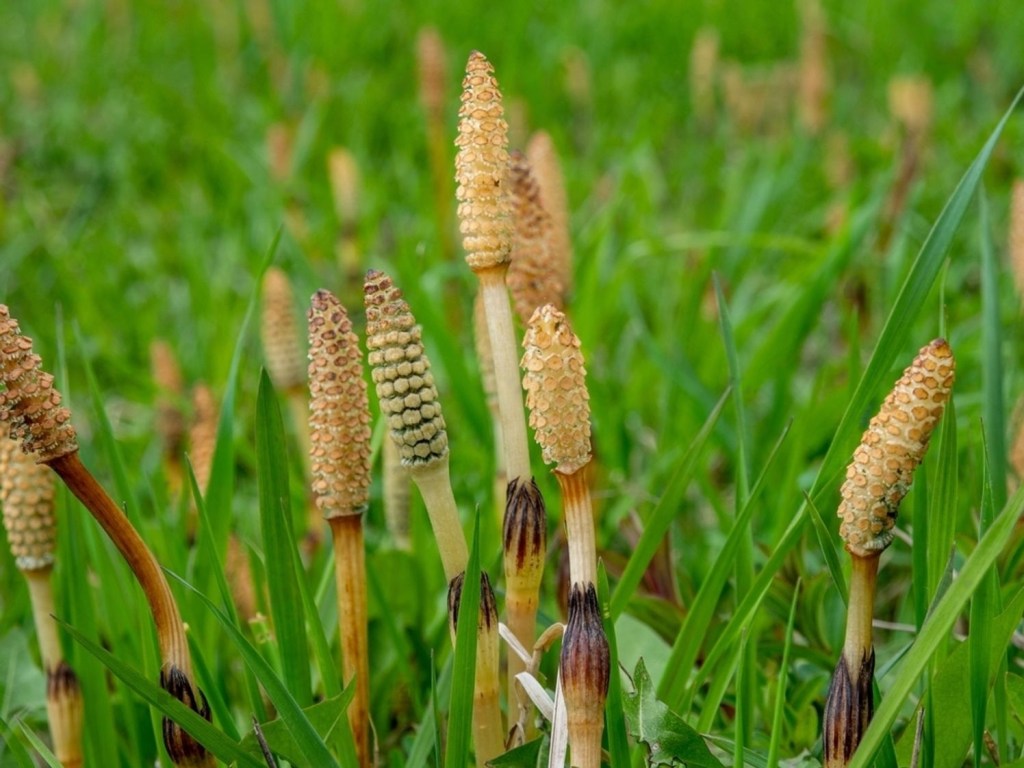

▷ IDENTIFICATION🔍
Common Name: Horsetail (Medicinal Horsetail)
Botanical Name: Equisetum arvense
Lookalike: Mare’s Tail (Hippuris vulgaris)
Herbaceous perennial plant Zones 4 to 9
Invasive and difficult to control.
Rare cases of skin sensitivity causing dermatitis, wearing gloves is advisable.
PRECAUTION: Can interact with several medications such as anti-seizure, anticoagulants (for high blood pressure), digoxin, anti-diabetes, diuretics, and HIV medications. Not appropriate for all, consider consulting a doctor first.
❗Children, pregnant, or breastfeeding: This plant may be harmful if used internally for young children, pregnant, or breastfeeding people. Research or speak with a healthcare professional. 🚼
▷ OTHER NAMES & LOOKALIKES 🏷️
Other Names 🏷️
◦ Field Horsetail
◦ Medicinal Horsetail
◦ Common Horsetail
Lookalikes 🔎
◦ Giant Horsetail (Equisetum telmateia var. braunii): Similar to field horsetail except taller and more robust with 4″ spore-bearing cones compared to field horsetail’s 1.5″ cones
◦ Scouring Rush (Equisetum hyemale): Same genus as field horsetail, however it’s fertile stems that are green have two black bands at the joints, which is unlike field horsetail’s two stem types.
◦ Restios (Restionaceae): Some species closely resemble horsetails due to the leaf sheaths around the joints.
◦ Common Rush (Juncus effusus): Some rushes look similar to horsetails, however lack nodes at the joints and have firm stems rather than hollow stems.
▷ APPEARANCE 🪞
Plant Description🌿🗒️
Stems are either fertile or sterile. Fertile stems emerge in the Spring, and are a grouped in a whorl and are pink, tan, or white. Each fertile stem has a circle of brown leaves at each node. The male strobilus, or “pollen cone”, produces pollen grains which are dispersed by the wind to reach the female strobili of the same species plants. After releasing pollen, the male pollen cone withers to form sterile stems, persisting from Summer until the first frost. Sterile stems may reach 1′ high, are waxy, green, branching, hollow, tough, jointed, photosynthetic, and non-reproductive. Field horsetail regenerates rapidly after a fire due to rhizomes, or roots, protected by being buried deep in moist soil.
Dimensions, Root Depth, and Spacing 📏↔️
Height: Fertile stems 9″ to 1′; Sterile stems 1′ to 3′
Width: 10″ to 18″
Root Depth: 6′ deep, 10″ to 20″ wide; Ideal minimum container size 7 gallon or 8 gallons. Larger containers allow plants to grow taller and wider!
Spacing: 10″ to 18″ apart
Flower Season and Fruit or Seed 🌻🍎🫘
Flower: The male strobilus, or “pollen cone”, produces pollen grains which are dispersed by the wind to reach the female strobili of the same species plants. Female strobili cones produce small spores which are dispersed by the wind to germinate into small gametophytes that produce either archegonia (female reproductive organs) or antheridia (sperm-producing). After releasing pollen, the male pollen cone withers to form sterile stems, persisting from Summer until the first frost.
Seed: Not relevant
▷ REPRODUCTION🌱
Sexuality: Asexual
Pollination: Pollen fertilizes wind-dispersed spores, which thereby germinate.
Growth Rate: Fast.
Propagation:
◦ Roots: From Early Spring to Late Fall, carefully dig up the entirety of the root system. Shallow digging may injure roots and cause health problems. Divide sections of the root system and replant.
◦ Cuttings: Plant cuttings that are ⅜” to ½” diameter (the wider the stem, the higher percentage of success) and 4″ to 6″ tall. Add cuttings to water and change the water every day for 1 month until roots form, later planting in soil in a container, or propagate by planting in soil during the Spring. Protect the new plant by placing it in partial sun or under a grow light until it has matured, avoiding direct sun.
Spore Germination: Requires moist conditions to germinate.
Indoor Planting: Grow plant for 1 year prior to transplanting outside 10 weeks after last frost date.
Outdoor Planting: Start cuttings 10 weeks after to last frost date.
▷ REQUIREMENTS❤️
Sunlight, Water, Fertilizer, and Pruning ☀️💧✂️
Sunlight: Prefers 6 hours full sun per day, tolerates slight shade.
Note: Avoid aerial watering, which encourages fungal growth and disease.
Outdoor Watering: Regularly water, keep soil moist. Grows in several inches of water, however intolerable of being fully submerged. Small pots require watering more often, especially if exposed to full sun, while large pots and shaded pots need less water.
Indoor Watering: Deep and infrequently, do not allow to dry, keep moist though avoid overwatering.
Drought Tolerance: May tolerate dry conditions once established, however will grow more slowly.
Fertilizer: Does not need fertilizer, dislikes fertile or rich soil
Pruning: Avoid pruning during Winter as it may kill the plant. This same rule applies for the Fall in northern climates. Remove bent, damaged, or dead stalks. Early Spring, cut the plant back to the soil level to help new, healthy growth and a full appearance.
Soil, Planting, and Environment 🌄🏞️🏜️
Soil: Prefers wet, sandy, gravelly, acidic soil. Very adaptable, may grow in a variety of conditions. Grows in several inches of water, however intolerable of being fully submerged.
pH: 6.5 to 7.5
Planting: When planting a potted plant, dig a hole that’s as deep as the pot and as wide as the root base. For plants with wide roots, dig a hole that is twice the width of the pot and gently space out the root system and then cover with soil to promote healthy growth. Burying tangled roots could cause health issues or stunted growth. The soil should be gently pressed in or watered in to fill the air pockets, preventing soil from collapsing in when watering or raining. Unplanted roots add to the stress of plants and could cause health problems or diseases. Cover every root with soil and smooth the soil’s surface.
Habitat: Moist soils such as streams, rivers, lakes, swamps, and embankments.
Temperature Preference and Temperature Tolerance🌡️
Temperature: Prefers 65°F to 75°F; Mulch roots to retain water and prevent evaporation.
Heat Tolerance: 100°F
Cold Tolerance: Foliage: 41°F; Roots: -22°F
Stems are killed by Winter cold and the root system survives to regrow in Spring
Salt, Wind, and Pollution Tolerance 🧂💨 ☣️
Salt Tolerance: No salt tolerance
Wind Tolerance: Moderate tolerance
Pollution Tolerance: Moderate tolerance
▷ ADDITIONAL INFORMATION📚
Description 📝
Field horsetail is a non-flowering weed that is native to North America, Asia, Europe, and the Middle East. It is a close relative of the fern and is considered a “living fossil”. The plant’s ancestors were tree-sized and dominated the landscape during the Carboniferous Period (354–290 million years ago), eventually transforming into coal deposits. As the plant dries, silica crystals form in the stems and branches, giving the plant a scratching effect and making it look like it has feathery tails. This is why horsetail has historically been used to polish metal, especially pewter.
Attract, Deter, and Repel Wildlife🐝🦋🐦🐌🪰🐇🦌
Deer and Rodent Resistant🦌🐇🐁
Attracts: Horsetail is eaten by caribou, sheep moose, and bears. The submerged parts of horsetail stems provide habitats for many small organisms, and the detritus from decaying plants provides food for these organisms.
Note: Animals attracted to the plant, including livestock, may die from consuming this plant due to high toxicity.
Repels: No known repelled animals.
Diseases and Pests🐜🦠
No known pests.
Herbicide Resistant.
Animal Toxicity and Medicine Interactions ☠️❤️🩹
Animal Toxicity: Toxic to livestock, especially horses. Kills livestock if enough field horsetail is consumed.
ASPCA Website, Toxic and Non-Toxic Plants “Field Horsetail”
Medicine Interactions:
Individuals may have a sensitivity or allergies to horsetail, consult a healthcare professional first and proceed at own risk.
◦ Anticoagulant and antiplatelet medicine (Blood thinners): Horsetail may slow blood clotting. Taking horsetail with medications intended to slow blood clotting may increase the risk of bruising and bleeding.
◦ Diabetes medication: Taking horsetail along with diabetes medications might cause blood sugar to drop too low. Monitor blood sugar closely.
◦ Diuretic medication: Increases urination frequency.
◦ Anti-seizure medication
◦ Digoxin, heart medication
◦ HIV medications
WebMD Website – Horsetail “Interactions”
Use and Harvest⚕️🌾
Use: Herbal remedy that has been used since ancient times to treat a variety of conditions. Horsetail contains silicon, which may relieve inflammation, promote urination, and strengthen bones. The high silica content of the stems makes horsetail useful for cleaning because of its abrasiveness. Horsetail extract has been used as a natural fungicide on crops. Externally applied in the form of herbal oil, poultice, therapeutic tea soak, salve, or cream. May be used for medicine, herbal tea, soups, or sautés.
Extended use of Horsetail may result in Vitamin B1 (Thiamin) deficiency.
◦ Essential Oil: Click Here for Precautions, Instructions, and Dilution Ratios
Benefits: Blood thinner (reduces blood clots), helps osteoporosis, broken or fractured bones, relieves kidney conditions, wound healing, ulcers, circulation, fluid retention, weight loss, kidney stones, urinary tract infections, improve fine lines and wrinkles, repair hair, nail deformity, and reduce longitudinal grooves in nails.
Dosing: ⅓ teaspoon dried herb 1 to 2 times each day for 1 week, then stop use for 1 month prior to continuing use. Continued use may cause dehydration and elimination of necessary vitamins and minerals from the body, eat nutritious meals and drink plenty of fluids while taking medicinal horsetail.
Click Here for How To Dry and Harvest Herbs and Seeds
Never harvest more than 20% of a plant’s leaves or roots!
Harvest: Best time is Late Spring, when the leaves are bright green and tall. Cut the stems at a few inches above the ground. Horsetail may also be removed by hand, as it breaks off easily at the nodes.
Flavor and Aroma, and Culinary Combinations🍴🧼
Grassy flavor similar to green tea, slightly bitter and earthy.
Aroma: Extract is a slightly sweet grass fragrance
Flavor: Pungent, slightly bitter, herbal, woody
Culinary Combinations: Horsetail compliments herbs and spices (chamomile, goldenseal, lavender, rose, hibiscus, elderberry, peppermint, lemongrass, and ginger)
Click Here to explore a comprehensive list of vitamins, minerals, and nutrients with function explanations, deficiency or excess symptoms, and vegan food source rankings (high, medium, low)
History 📜
The oldest remains of the genus Equisetum, which includes the field horsetail (Equisetum arvense), date back to the Early Jurassic period, approximately 150 million years ago.
Lifespan ⏳
At least 2 years to several years longevity for life expectancy
 Vegan Botany