
This is for informational purposes only. For medical advice or diagnosis, consult a professional.
🐝🦋 Popular pollinator attractor
🌎 Native to Midwest North America
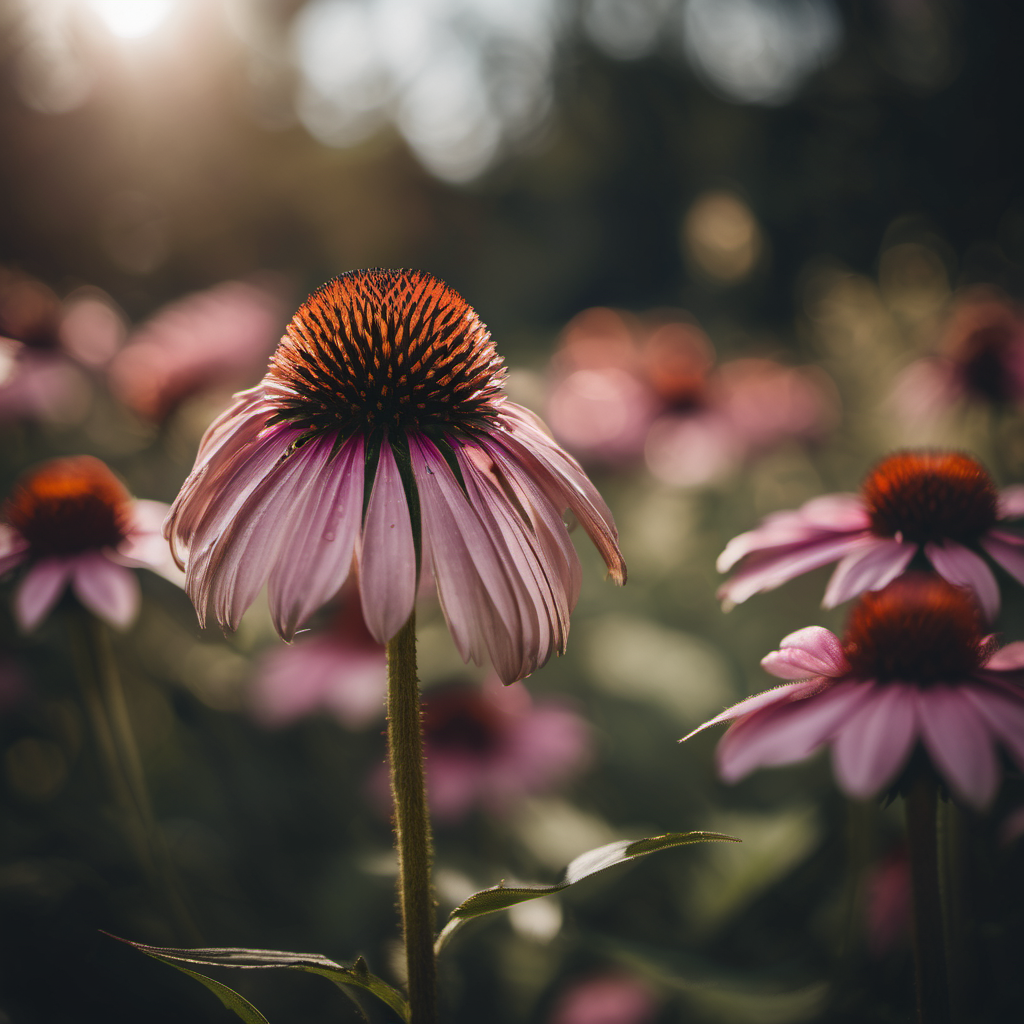
▷ IDENTIFICATION🔍
Common Name: Echinacea
Botanical Name: Echinacea purpurea
Family: Aster family (Asteraceae)
Endangered herbaceous perennial for Zones 3 to 9
PRECAUTION: May interact with caffeine, anticoagulant medications, and immunosuppressant medications. Not appropriate for all, consider consulting a doctor first. See section “ADDITIONAL INFORMATION > Animal Toxicity and Medicine Interactions”.
❗Children, epileptic, pregnant, or breastfeeding: This plant may be harmful if used internally for young children, epileptic, pregnant, or breastfeeding people. Research or speak with a healthcare professional. 🚼
▷ OTHER NAMES & LOOKALIKES 🏷️
Other Names 🏷️
The Echinacea genus name comes from the Greek word “echinos“, which means “hedgehog” or “sea-urchin”.
◦ Purple Coneflower
Lookalikes 🔎
◦ Black-eyed Susan (Rudbeckia fulgida): This aster family plant has varieties with petals that bend away from the central cone.
◦ Yellow Coneflower (Echinacea paradoxa): Vibrant yellow petals and a bristly cone center.
◦ Echinacea Sombrero Adobe Orange (Echinacea x hybrida): This plant has bright pumpkin orange flowers and can grow to about two feet tall.
▷ APPEARANCE 🪞
Plant Description🌿🗒️
This endangered, native herbaceous herb grows in a basal rosette and is ideal as a pollinator garden border, for meadows, and naturalized areas. In the Spring, new red shoots emerge, later developing into a cluster leaves that reach 3″ to 6″ length and 1″ to 3″ wide. Leaves are green, lance-shaped leaves with serrated edge margins on fuzzy, branching stems. Higher leaves are arranged in an alternating pattern. As Spring progresses, rosettes become denser and bloom stalks grow tall. Flowers reach 5″ diameter, occurring at the top of stem, with domed, spiny-centered, brown-red center that is surrounded by 15 to 20 bright pink rays (petals). The petals are 1.5″ to 3″ length and ¼” to ¾” width, each with 3 notched teeth at each end.
Dimensions, Root Depth, and Spacing 📏↔️
Height: 2′ to 4′
Width: 18″
Root Depth: Taproot may reach 5′ deep; Ideal minimum container size 7 gallon or 8 gallons. Larger containers allow plants to grow taller and wider!
Spacing: 1′ to 3′ apart
Flower Season and Fruit or Seed 🌻🍎🫘
Flower: 5″, hot pink flowers from Early Summer to Fall.
Seed: Small, white, narrow triangle-shaped seeds
▷ REPRODUCTION🌱
Sexuality: Hermaphrodite
Pollination: Hummingbirds, bees, butterflies, and other beneficial pollinators.
Growth Rate: Fast
Propagation:
◦ Roots: Carefully dig up the entire plant. Cleanly cut different pieces of the plant that have both attached roots and foliage and replant. Water regularly to help the roots grow and promote foliage production by reducing the plant’s stress.
◦ Cuttings: From non-flowering stems, plant cuttings ⅜” to ½” diameter (the wider the stem, the higher percentage of success) and 4″ to 6″ tall. Add cuttings to water and change the water every day for 1 month until roots form, later planting in soil in a container, or propagate by planting in soil during the Spring. Protect the new plant by placing it in partial sun or under a grow light until it has matured, avoiding direct sun.
Seed Germination: Cold stratification for 28 days may speed up germination. Soil pH 5.5 to 7.2 at preferably 65°F to 75°F, kept moist, however not wet or dry. Plant seed ¼” deep, emerges 5 days to 20 days after being sown. Germination rate of 68% (depending on producer).
Indoor Planting: Grow plant for 1 year prior to transplanting outside 10 weeks after last frost date.
Outdoor Planting: Plant seed after the last frost date.
▷ REQUIREMENTS❤️
Sunlight, Water, Fertilizer, and Pruning ☀️💧✂️
Sunlight: Prefers 6 hours to 8 hours full sun, minimum 4 hours full sun; Tolerates partial shade.
Note: Avoid aerial watering, which encourages fungal growth and disease.
Outdoor Watering: Water when the top few inches of soil are dry, usually regularly during Summer (every 2 to 4 days) and less frequently in the Winter (every 1 to 3 weeks). In warmer regions, afternoon shade can help prevent the flowers from fading. Tiny pots and K-cup seed starters need water every day during Summer and every 2 days during Winter. Small pots require watering more often, especially if exposed to full sun, while large pots and shaded pots need less water.
Indoor Watering: Deep and infrequent, allowing for soil to dry on the top layer prior to more water.
Drought Resistance: Drought tolerant once established
Fertilizer: At the start of the growing season, apply fertilizer every 4 weeks to 6 weeks. Scatter evenly at the base of plants, avoiding clumps of fertilizer and preventing contact with stalks and stems. Large clumps of fertilizer won’t evenly supplement nutrients into the entire soil surface after it mixes with water from rain or irrigation. Fertilizer clumps around the base of plants make cause the main stalk to rot or have contact burns, which could damage or kill the plant. Do not throw fertilizer over plant tops, as the clumps of fertilizer caught in between leaf nodes and on foliage may either burn or rot the foliage.
Pruning: Avoid pruning during Winter as it may kill the plant. This same rule applies for the Fall in northern climates. Remove withered flowers, dead leaves, and leggy stems to enhance plant’s appearance. This also promotes new stems to appear with more leaves and flowers.
Soil, Planting, and Environment 🌄🏞️🏜️
Soil: Well-drained, moist, sandy loam. Intolerable of wet soil.
pH: Prefers 6.5 to 7.0; Tolerates 6.0 to 7.0
Planting: When planting a potted plant, dig a hole that’s as deep as the pot and as wide as the root base. For plants with wide roots, dig a hole that is twice the width of the pot and gently space out the root system and then cover with soil to promote healthy growth. Burying tangled roots could cause health issues or stunted growth. The soil should be gently pressed in or watered in to fill the air pockets, preventing soil from collapsing in when watering or raining. Unplanted roots add to the stress of plants and could cause health problems or diseases. Cover every root with soil and smooth the soil’s surface.
Habitat: Rocky prairies, valleys, and sparse woodland. Native to the eastern ⅔ of the United States, from Ohio to Michigan to Iowa, and south to Louisiana and Georgia. Also found in the Canadian province of Ontario. Most common in the Ozarks and the Mississippi/Ohio Valley.
Temperature Preference and Temperature Tolerance🌡️
Temperature: 65°F to 80°F
Heat Tolerance: May tolerate 95°F to 105°F, hotter than this may damage the foliage and flowers. Drought tolerant once established.
Cold Tolerance: -30°F; Mulch roots to retain water and to protect the root system from the cold during Winter. Keep dead leaves on the plant during Winter as a shield to protect the plant, then cut back in the Spring to promote new foliage growth.
Salt, Wind, and Pollution Tolerance 🧂💨 ☣️
Salt Tolerance: Low tolerance
Wind Tolerance: Moderate tolerance
Pollution Tolerance: Low tolerance of urban and inner city pollution
▷ ADDITIONAL INFORMATION📚
Description 📝
Echinacea purpurea is an endangered, medicinal perennial herb that is native to the central and southeastern United States
Attract and Repel Wildlife🐝🦋🐦🐌🪰🐇🦌
Deer and Rodent Resistant🦌🐇🐁
Attracts: Hummingbirds, songbirds, bees, butterflies, and other beneficial insects
Repels: Mosquitoes and houseflies
Diseases and Pests🐜🦠
Note: Proper care keeps plants resilient and healthy, preventing diseases and pests. This list details the potential threats, specific diseases and pests vary depending on environmental climate.
Diseases:
◦ Anthracnose
◦ Aster Yellows
◦ Fusarium wilt: A common disease caused by a seedborne fungus that stunted growth, wilting, or brown vascular tissues. Infected plants and seeds should be destroyed, and that family of plants shouldn’t be planted in the same area for 2 years to 3 years to prevent reinfection.
◦ Leaf Spot: A diseased or discolored area on a leaf caused by a plant disease or injury. Leaf spots may be caused by fungi, bacteria, or viruses, or by injuries from insects.
◦ Powdery Mildew: Disease caused by a fungus due to overwatering or overcrowding, making the plant vulnerable to other pests and diseases
◦ Stem Rot
Pests:
◦ Aphids: Small, soft-bodied sucking insects which pierce plant tissues and draw out the juices.
◦ Eriophyid mites
◦ Japanese Beetle
Animal Toxicity and Medicine Interactions ☠️❤️🩹
Animal Toxicity: Safe for dogs, cats, and horses.
Medicine Interactions:
Individuals may have a sensitivity or allergies to PLANTNAME, consult a healthcare professional first and proceed at own risk.
◦ Caffeine: Echinacea might decrease how quickly the body breaks down caffeine. Taking echinacea along with caffeine might increase levels of caffeine and increase the risk of side effects from caffeine, such as jitteriness, headache, and fast heartbeat.
◦ Medications changed by liver (Cytochrome P450 1A2 (CYP1A2), and (Cytochrome P450 3A4 (CYP3A4). Mint may change how quickly the liver breaks down medications prone to being changed or broken down by the liver. This could change the effects and side effects of these medications.
◦ Immunosuppressants (decreases immune system): Echinacea may increase the activity of the immune system. Some medications, such as those used after a transplant, decrease the activity of the immune system. Taking echinacea along with these medications might decrease the effects of these medications.
◦ Etoposide (VePesid): Echinacea might decrease how quickly the body breaks down etoposide. Taking echinacea along with etoposide might increase the side effects of etoposide.
◦ Midazolam (Versed): Echinacea affects how quickly the body breaks down midazolam. Taking midazolam with echinacea might increase the side effects or decrease the effects of midazolam.
◦ Warfarin (Coumadin) (anticoagulant): Warfarin is a blood thinner used to slow blood clotting that blocks the body’s ability to use vitamin K, which is a vitamin that helps clot blood. Echinacea might increase the breakdown of warfarin and decrease how well warfarin works. This might increase one’s risk of having a clot. Be sure to have blood checked regularly. The dose of warfarin might need to be changed.
◦ Darunavir (Prezista): Echinacea might affect how quickly the body breaks down darunavir. Taking echinacea along with darunavir might increase the risk of side effects or decrease the effects of darunavir.
◦ Docetaxel (Taxotere) interacts with ECHINACEA Echinacea might affect how quickly the body breaks down docetaxel. Taking echinacea along with docetaxel might increase the risk of side effects or decrease the effects of docetaxel.
◦ Etravirine (Intelence): Echinacea might affect how quickly the body breaks down etravirine. Taking echinacea along with etravirine might increase the side effects or decrease the effects of etravirine. But it’s not clear if this is a big concern.
◦ Lopinavir or Ritonavir (Kaletra): Echinacea may affect lopinavir or ritonavir. Taking echinacea with this medication might change how quickly the body breaks down this medications and may increase the side effects or decrease the effects of lopinavir or ritonavir.
WebMD Website – Echinacea “Interactions”
Use and Harvest⚕️🌾
❗Never ingest essential oils, instead use organic fresh or dried herbs.
Use:
Echinacea is a popular herbal remedy in the United States, and was used in traditional medicine by Native American tribes. Commonly used to stimulate the immune system during colds, flu, upper respiratory tract infections, or bladder infections. Flowers and roots have higher antioxidant levels and other medicinal properties that the leaves. Using echinacea for more than 8 weeks may harm the liver and suppress the immune system. Boosting the immune system too much can also cause problems, especially for people with an autoimmune disease.
◦ Flower Petals, Leaves, and Roots: May be used sparingly as fresh as a garnish or dried in herbal supplements Externally applied in the form of herbal oil, poultice, salve, cream, or therapeutic tea soak.
– Essential Oil: Click Here for Precautions, Instructions, and Dilution Ratios
Benefits: Blood thinner (anticoagulant, reduces blood clots), anti-inflammatory (reduces internal and external swelling), antioxidant (protects cells), antimicrobial, antibacterial, antiviral, antidisease, anticancer, antimutagenicity, antiulcerative (ulcer relief), strengthens immunity, prevents infection, relieves pain, colds (flu or influenza), fever, headache, cough, sore throat, respiratory tract infections (bronchitis, chest congestion, pharyngitis, and whooping cough), arthritis, shingles, chickenpox, acne, bites, stings, depression, and anxiety. May be used to help those with seizures, consider researching and consulting a doctor.
Dosing: Steep 1 teabag for 3 to 15 minutes or 1 or 2 teaspoons of fresh flower steeped for 10 to 15 minutes. ⅛ teaspoon to ¼ teaspoon may be used for culinary applications every other day for adults. Use for no more than 10 days, then stop use for 2 weeks prior to continuing use
Click Here for How To Harvest, Dry, and Properly Store Herbs and Seeds
Harvest: Never harvest more than 20% of a plant’s leaves or roots!
◦ Flowers: From Early Summer to Fall
◦ Leaves: Harvest bright, healthy leaves at any time
◦ Roots: Dig the roots up, scrub away dirt, dehydrate, and store in an airtight container.
◦ Seeds: Harvest the dry, brown, crunchy flowers. Follow harvesting techniques in the link above to extract and properly store the seeds.
Aroma, Flavor, and Culinary Combinations🧼🍴
Echinacea’s medicinal compounds can also have a tongue-tingling effect.
Aroma: Honey
Flavor: Flower petals are a bitter, floral flavor. Leaves are fibrous with a fresh, grassy flavor. Roots have a strong floral, earthy flavor with notes of pine needle.
Culinary Combinations: Compliments herb and spices (thyme, sage, rosemary, oregano, mint, chamomile, elderberry, chamomile, rose, hibiscus, goldenseal, lemongrass, ginger)
Click Here to explore a comprehensive list of vitamins, minerals, and nutrients with function explanations, deficiency or excess symptoms, and vegan food source rankings (high, medium, low)
History 📜
Echinacea purpurea, also known as the purple coneflower, has been used for medicinal purposes for over 400 years by Native Americans. The first archaeological evidence of its use dates back to the 18th century. Native Americans used the plant to treat many ailments including snakebites, insect bites, wound healing, infections, headaches, toothaches, and sore throats. They also used the juice for bathing burns and in purification ceremonies.
Lifespan⏳
10+ years longevity for life expectancy.
 Vegan Botany